From Prompts to Processes: Building More Effective AI Workflows
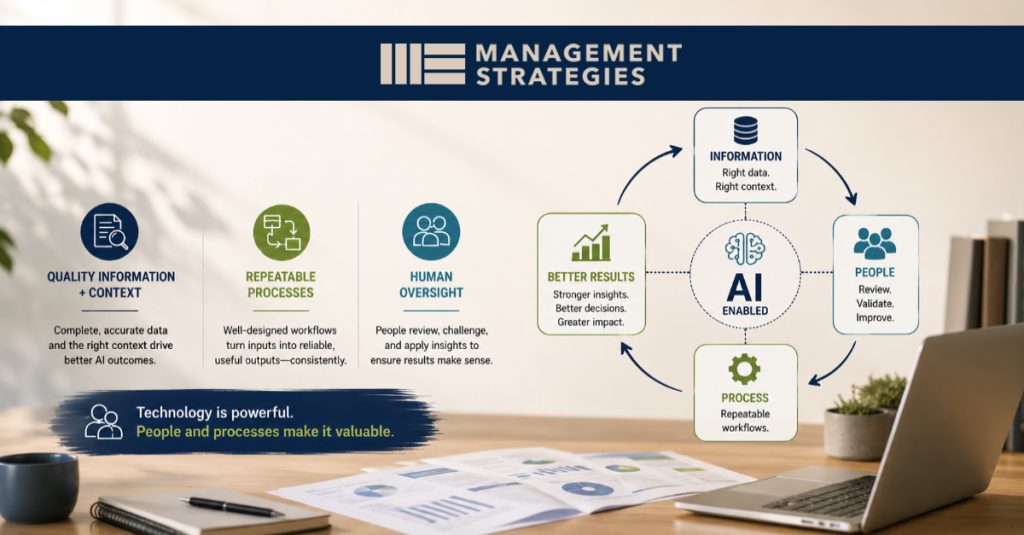
Artificial Intelligence (AI) is quickly becoming part of the modern workplace, promising to help teams work faster, analyze information more effectively, and reduce administrative burdens. Yet access to AI alone does not guarantee added business value. The challenge is often not whether an organization has access to capable technology, but whether the organization has developed an effective process for using AI. Reliable results depend on more than a well-written prompt — they depend on the information available to the technology, the context surrounding that information, and a repeatable process for turning those inputs into useful outputs.
As organizations mature in their use of AI, the conversation should move beyond prompt engineering and toward process design. Teams need to consider what information feeds an AI-enabled workflow, whether that information is complete and useful, what context is needed to interpret the information, what a successful output should look like, and how a human will review that output. The quality of an AI-enabled process depends not only on the technology, but also on the quality of the information supporting it and the process used to turn that information into useful results. Organizational knowledge, including preferred terminology, stakeholder context, established procedures, previous work products, and lessons learned can provide context that a prompt alone may not capture. Building that knowledge into a repeatable workflow helps organizations apply it consistently rather than relying on individuals or disconnected resources.
AI can also help organizations analyze information and surface connections or potential insights that they may otherwise have missed. However, organizations should not treat an AI-generated insight as a correct conclusion. The quality and completeness of the underlying information matter, and people who understand that information and the business context remain essential. While reviewing AI-generated output, people must determine whether a finding makes sense, recognize when something does not pass a basic “smell test,” identify missing or conflicting information, and decide how an insight should be applied.
At Management Strategies, we believe technology creates the greatest value when it strengthens people and processes rather than attempting to replace them. Successful AI adoption requires more than access to increasingly capable tools—it also requires thoughtful management of information, clearly defined workflows, human oversight, and continuous improvement. The organizations that realize the greatest value from AI may not be those with the most tools or the most sophisticated prompts, but rather those strengthened by users who have the skills to build the strongest processes around them.